Regenerative Money Farming
Proof of Concept · Key to Eden ICLS
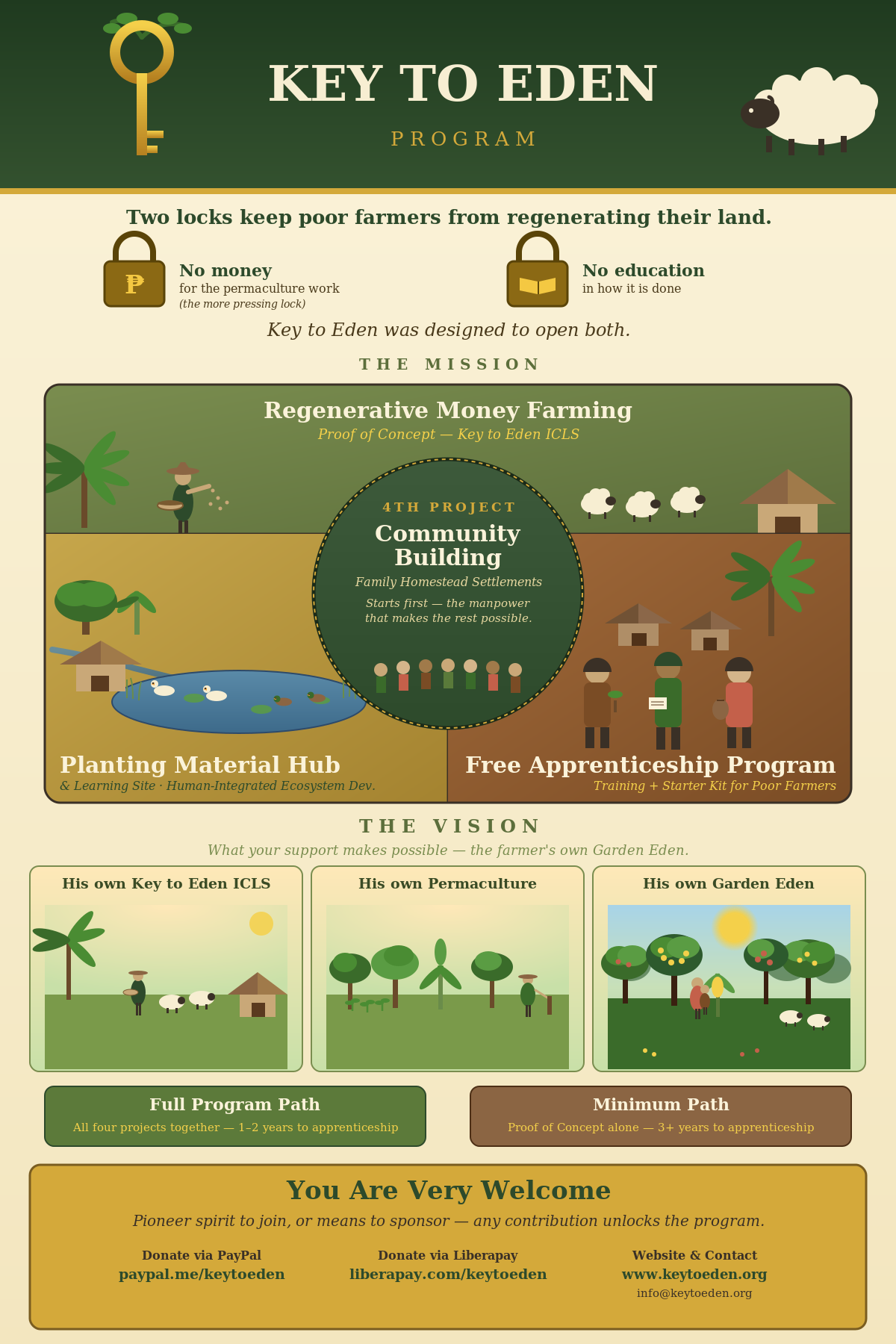
An integrated crop-livestock system, profitable from the first harvest. The income engine, and the in-the-field documentation of the method.
A regenerative crop-livestock program for poor tropical farmers — built around a system that pays from the first harvest.
for the permaculture work
(the more pressing lock)
in how it is done
Key to Eden was designed to open both.
All four projects support and depend on each other. Run together, the four projects bring the apprenticeship program into operation in one to two years.
Proof of Concept · Key to Eden ICLS
An integrated crop-livestock system, profitable from the first harvest. The income engine, and the in-the-field documentation of the method.
Human-Integrated Ecosystem Development
A living source of trees, seeds, and design knowledge on the project's own land, growing year by year. A nursery is added inside the ecosystem as funds allow.
Training + Starter Kit for Poor Farmers
Permaculture training, plus a starter kit (seeds, animals, an electric sheep fence, and an allowance to cover daily needs until the first harvest), so each graduate can carry the work home.
Family Homestead Settlements
The fourth project — equal in importance, started first, because the small group of devoted people whose work makes the other three possible to run in parallel does not yet exist. We will find and form it. Around 250 hectares ideally on expandable land, sized for roughly 150 family homesteads plus communal areas and a wildlife zone.
Each working unit is a 100 m² paddock (5 m × 20 m), enclosed in electrified sheep netting. A seed mix of guild species — Sunn Hemp, Alyce Clover, Daikon Radish, Japanese and Browntop Millet, Pearl Millet, Red Ripper Cowpea, Sunflower, Brown Mustard, Sesame and others — is broadcast over the paddock. Sheep graze the paddock for one day; their hooves trample the seed into firm soil contact, and their dung begins the fertilization cycle. The flock is moved daily into the next freshly sown paddock via two leap-frogged netting systems.
First harvests start around sixty days; longer-cycle crops complete the big cycle of about 120 days. Soil improves every cycle. The farmer is left with steadily improving soil, replicable seed stock, and cash income to fund the earthworks and perennials of a permaculture design.
About 2 hectares is the practical anchor for a full pilot. Smaller farms remain workable on a reduced rotation.
The system pays from the first harvest. Daily-rotated 100 m² paddocks replace the heavy weeding, plowing, and chemical inputs of conventional agriculture. More income for less work — the most concrete reason a poor farmer takes the leap.
Development-aid projects in Northern Mindanao have ended when the supporting organisation withdrew — facilities empty, tractor wheels cemented into the floor of an abandoned shed. Key to Eden's inputs are seeds and animals that the farmer himself multiplies; the only piece of technical equipment is a fence charger, with a farmer-buildable version in development. Once seeded, the program propagates itself.
Four projects run in parallel because each one needs the others. Together they reach apprenticeship operation in one to two years. Earlier results mean earlier resilience — for farmers and for the communities that depend on them.
Donors fund a system that gives poor farmers food, income, education, and a regenerating piece of land. In return, more than satisfaction: the new ecosystems produce oxygen we all breathe, soften temperature extremes and wind, and turn concentrated storm-rain into misty distributed rainfall over ever larger areas — ideal growing conditions that increase food security across regions. If we engage wholeheartedly, food security for all on this planet is within reach inside a decade.
Reports, the Key to Eden book, the seed guild, the design knowledge built here — free for anyone to use. Donations received are publicly listed on the Liberapay page; spending reports follow on a regular cadence. The people the method is built for are the ones with the least to give in return.
Christoph Erhard Day. German national, precision engineer by training, sixteen years on a smallholding in Northern Mindanao, self-funded throughout. Field observations, plant inventories, soil notes, and the writing of the book are entirely his own work.
The system was invented because I could not afford the permaculture earthworks I wanted on my own farm. Not macht erfinderisch — necessity is the mother of invention.
Your contribution funds the recurring work that keeps the program alive — seed multiplication, animal care, daily operations of the pilot, and the build-out of the program. The rewards are both direct and visible: more oxygen and balanced microclimates from the living ecosystems we plant; rains that distribute more evenly as misty cover rather than concentrating into damaging storms; food security that strengthens for the region and, at scale, for the planet. And the reports and videos that come back from the field, so you see what your support has actually moved.
paypal.me/keytoeden
Easy direct support, any amount.
liberapay.com/keytoeden
Recurring weekly / monthly support. Donations listed publicly.
Suitable land is one of the highest-leverage contributions any supporter can make. If you own a parcel in the Philippine lowland — or you sit in a government agency (DAR, DENR, NCIP, DA) or a university with land that could host this program — please get in touch. Around 250 hectares of expandable land is the ideal. We are equally glad to talk with private owners and with public bodies.
Other collaboration welcome from: agricultural universities and colleges in the Philippines, DENR, DAR, NCIP, DA, farm landowners, agronomists, seed suppliers, permaculture designers, and anyone with experience in or passion for tropical smallholder regeneration. Once the pilot site is open, volunteers with a pioneer spirit will be welcome on the ground.
Current posts, field updates, and open questions from the project — follow along or join the conversation.